Loading...

Saturday, May 28, 2011

60L Video on Vimeo.com

Youtube restricted this video in some countries, so I upload it again but in a different host; in Vimeo.com. I hope that this avoid any kind of restrictions and anyone can see it. Any problem just let me know.


One Step Closer ' 40 days after Setup from FAAO on Vimeo.


Setup (15.April.2011)
Aquarium: 55x35x35 cm (L x T x W)
Lighting system: ELOS E-Lite Leds Technology
Filter: Hang on filter
Substrate: ELOS Terra Zero + ELOS Bottom Mineral + ELOS Terra (small)
CO2 System: ELOS Set-ECO with Solenoide valve 1,2bps
Plants from Aquaflora: Hemianthus callitrichoides cuba, Anubias nana mini (petit) and Eleocharis aciculares.
Fertilization: Elos Fase1, Fase2 and K40
Music by: Israel Kamakawiwo Ole - Somewere Over The Rainbow

Friday, May 27, 2011

The new DaniReef project: the Tank

I thanks Filipe for the opportunity he gave me to write on his wonderful blog.

As I write mainly towards Marine Aquarium, I would like to began to write about my system, that compare with normal fresh water tank, is quite bigger.

From the problem of my previous tank that after two years had almost completely unstuck (see here), I ordered a new tank and thanks to Alessandro Falco who lent me his aquarium to keep “on holiday” my adored fish, I managed at last to take off.


The choice of measures has been to prefer a tank that would give the idea of being large, so a very wide format, despite the height. So I confirmed the length of the front window of 130 cm, while I had to settle of a width of 60 cm, and a total height of 50 cm, which might give a more wide aquascape, this also because of the layout I have in mind and you’ll see soon.


Even the furniture was finally built to measure, and I say finally especially for those who remember of the previous one… that I wanted but that I never finished, thanks to my proverbial manual skills ;-)


Forniture and tank have been ordered to Elos and I had to wait a month before the delivery order, I was actually very lucky, it is often necessary to wait up to 2 months from the order, for oversized items.

The bottom of tank is constructed by two layers of glass glued together in a staggered, as shown in next photo, which notes the characteristic bonding Elos.


The overflow, for obvious aesthetic reasons, has been placed on the far left, and is very tiny, measuring 15×11, 5 cm outside, inside is empty and has the two hoses for loading and unloading.

Into the overflow you can see the sump, that for now it’s empty


The tank will have a cycling accelerated as soon as possible to enter the fish as I said I’m managing to another aquarium, and then take two aquarium together is not the best economically. I will use very few rocks, and begin with live sand. The rocks come from an existing aquarium, and even the light will start immediately with 4 hours.

For now I leave you with pictures of the tank just in place, expect comments, criticisms, questions, and why not … ideas …

Good vision

DaniReef

Thursday, May 26, 2011

About Planted Aquariums

Planted Aquariums
By Filipe Oliveira

Difficult?
Of course not!
Setup a beautiful planted tank is not so difficult as people think! Choosing the right equipments, additives, soil and plants, this will help to keep a planted aquarium. Of course that when we talk about beauty this is relative, what is beautiful for a person can be ugly or indifferent for others, but is this what distinguish us as human beings.
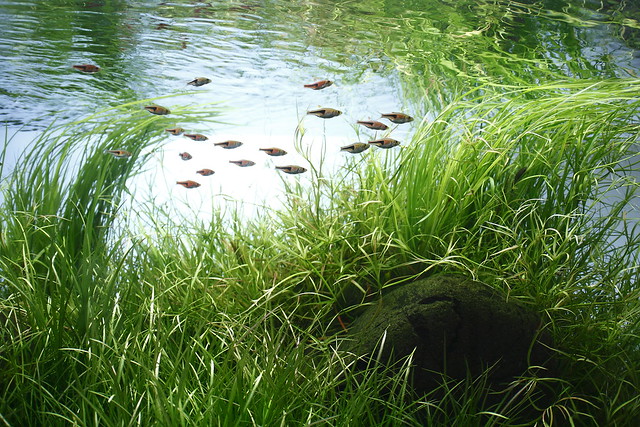
Oasis
Each planted tank is a planted tank and the most important thing is that persons do it according to their needs and the time that they have to spend daily for maintenance. In case of having some fishes in old Aquariums, the layout needs to be adjusted to their needs, maybe this can reduce the variety of plants, but it is possible to do something beautiful.
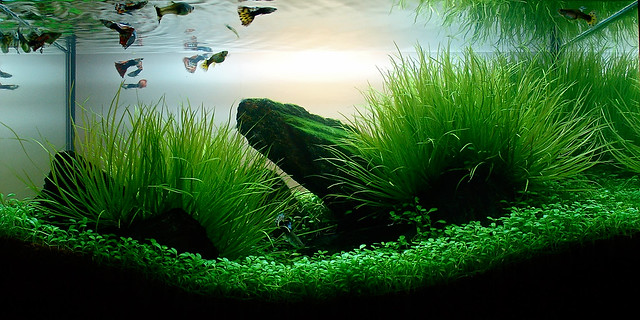
Rise beyond the limits

Light the source of life.
Light is so important for a planted aquarium?
Sun is our source of life in Earth, without it is impossible to keep any live plant and of course the oxygen to breath. For Aquatic plants occurs the same, each plant has different needs and having a good quantity of light in aquarium will never be a problem because you can always keep low light plants under a good amount of light but the opposite not, the plants can simply die or do not grow.
ratio of light
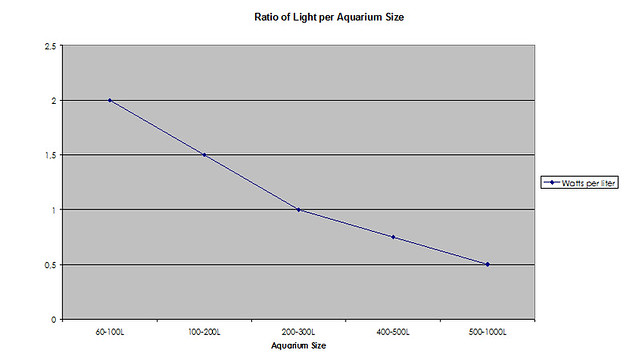
The ratio of light for a planted tank is measure by the volume of water that we have on the aquarium; is higher in small tanks (1 or 2 watts per liter) and decreasing the ratio when the aquarium gets bigger.
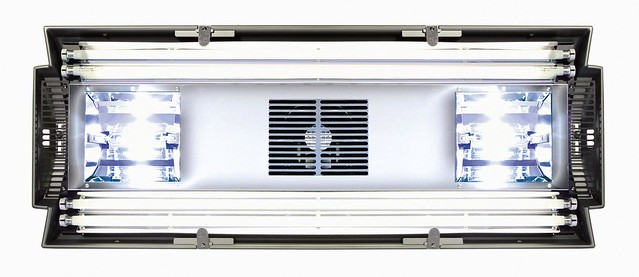

ELOS PlanetII


The first thing that needs to be chosen very carefully is the lighting system. There are too many lighting systems in the Aquarium market; some uses metal halide bulbs, T5, T8, power compact and recently the LED. My favourites are HQI (metal halide) and LED, then comes the T5 and T8; Power compact can be used because provide us a good quantity of light in a small size, but it isn’t easy to find good and quality bulbs for that system, so for that reason I prefer not use. What I like most in HQI and LED, of course when we use good LEDs and Metal Halide bulbs with high level of CRI (Colour Rendition Intensity), because they emit approximately the light from the sun. The higher is the CRI and near of 100%, better they are. Power doesn’t mean intensity, if we have 70watts of power, whatever is the intensity, we still have 70watts. T5 and T8 are a good combination for HQI, but in my humble opinion, they will be replaced very soon for LED. In case of using only T5 or T8, the better option is use different spectrums between 4.000k to 10.000k.

Decoration Sand or Natural soil?


Which is better for the plants?
If we bring this subject to Nature, we can easily see that in natural soil the terrestrial plants grow better than in sand. At home, if we want to keep plants in pots we use special soil to give to the plants nutrients on the roots for a healthy growing, but why we don’t use sand instead of soil? Plants needs soil rich in nutrients; a soil that lets the roots growing and do not struggle them, and keep some humidity.
On planted aquariums we can provide nutrients below the sand using rich substrate, but what will happens to the roots of the plants when they start growing? Some plants have difficult to spread in sand and some roots just die because the sand compact too much and struggle their growing; for this reason some brands just provide us special soil for aquatics plants, that lets plants growing like in nature and because of its porosity can keep a biological system on the soil to get a balanced Aquarium for plants and fishes.
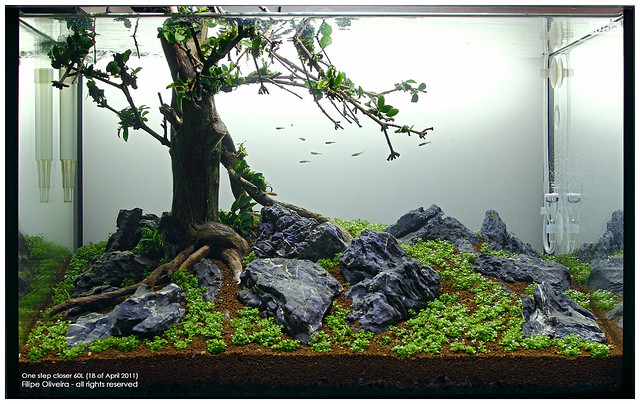

One Step Closer 60L ' 18.04.2011
Sand can be used to decorate some parts of the aquarium; zones that we want to give more details and contrast, and let the plants on the soil for a healthy growing!
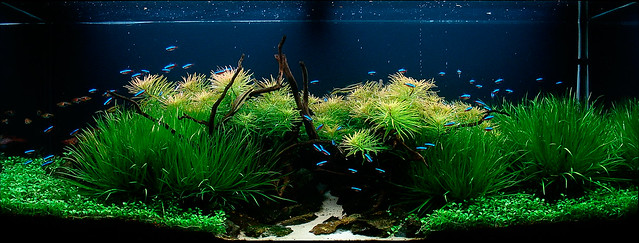
Across the River


CO2 Fertilization
Harmful for fishes and plants?
CO2 is very important for plants because they will use it for photosynthesis. If we don’t use CO2 on planted aquariums, plants will not grow as expected and algae will appear.

CO2 Ato10


Only in Aquariums with good amount of light is that plants do the photosynthesis, otherwise and if we don’t have light enough the CO2 will not be absorbed and in this case will be harmful for fishes. Plants absorb CO2 during photosynthesis and release O2 to the water, so fishes will have always oxygen on the water to breathe during this process. The photosynthesis only occurs when we have light on the aquarium, so when the light turns on, the plants will start the photosynthesis process and in this moment we need to start the injection of carbon dioxide on the water.
The comfortable way to starts the injection of CO2 on the water is using a solenoid valve connected to a timer, with this we can schedule when the lights turn on and starts the injection of CO2. Solenoid valve permits to turn on and turn off the CO2; stopping the injection of CO2 on the water when the lights turn off, keeping the fishes safety of an overdose of CO2 and breathing problem, because during the time that lights are turned off we don’t need to inject CO2 on the water.
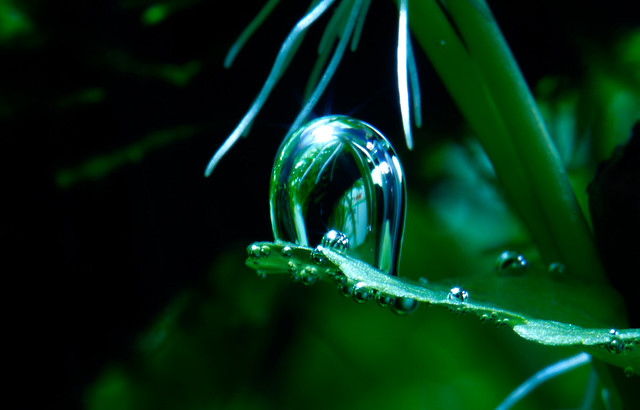
CO2 Pearling
Picture of Pearling; Photosynthesis process. The plant absorbed Carbon Dioxide and is releasing Oxygen.


How to setup a planted aquarium.
What we need?
An aquarium, substrate rich in nutrients, soil, wood or rocks, aquatic plants, CO2 equipment, lighting system, filter and planting tools.
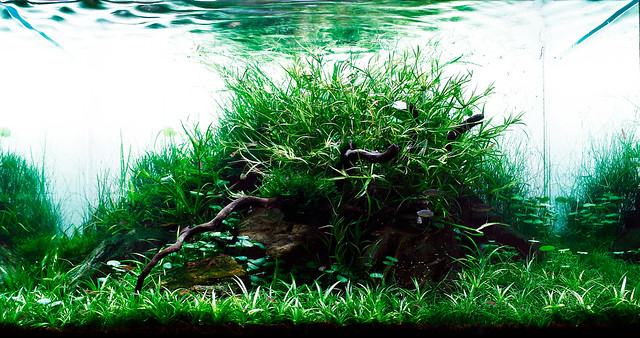
Enchanted Forest


Any aquarium can be used to set up a planted tank, but if it is possible we should avoid using taller and tight measures because the layout will be out of proportion and more difficult to do. A taller aquarium needs more light and forces us to do a big slope of soil on the back to get grown plants at 1/3 of water surface. The tight aquarium (no depth) reduce the working area and when we start planting it seems that is everything so close; to give some depth to the layout is very difficult and only persons with skills can do it. Usually, I look for measures that give me some wide view, like we are seeing a 16:9 wide TV and some depth to place the rocks, woods and plants without being so close of each other.

Next step is chose the correct plants for each aquarium, but and if we don’t know what to use?
When I started in planted aquariums, I tested and studied a lot of plants and their growing, colour, volume, details, etc; but on that time there wasn't too much information on the internet. In ours days, it is possible to find a lot of information about aquatic plants and even that we don’t know their names, it is a question of visit the website of some plants wholesalers to get the right information.
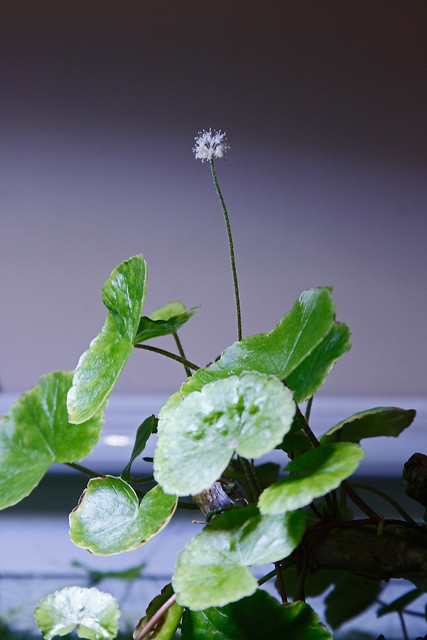

Hydrocotyle Flower


Other way is to analyze the aquariums of others hobbyists and see the set up of each tank to know what they used and then start looking for the plants on web through a search engine… too easy compared to several years ago! In a planted aquarium we can divide the plants by 3 types, foreground, middle and background; if we respect that, for sure that we have half a job done; the other half, free your creativity!


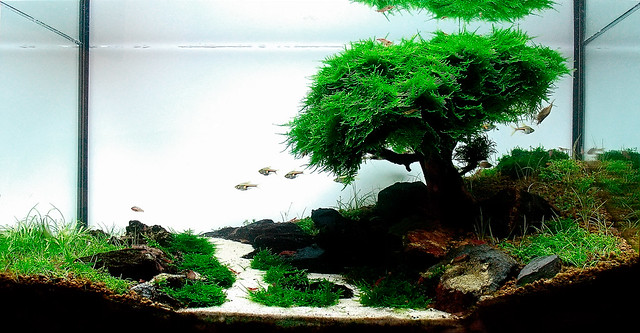
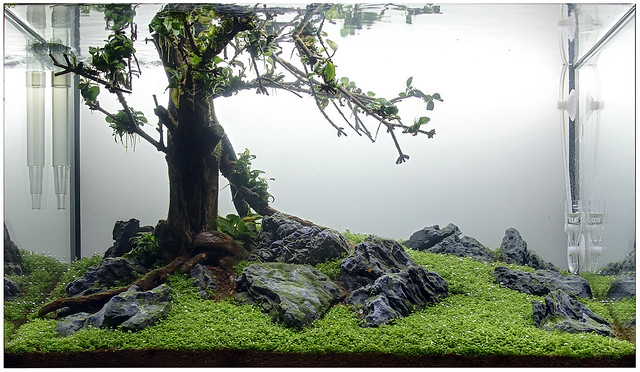
The planted aquarium that I will show below came from a moment of creativity. There isn’t such thing called water bonsai… The tree was made with several pieces of wood attached to a main branch and some aquatic moss tied to the tiny branches.


This was my first attempt to recreate a tree scape on aquarium and with good results.


Syrah Planura


Some people when saw it during setup and growing process, told me that it wouldn’t be possible to keep such quantity of moss in a small piece of wood; but they were wrong! Of course that I had to have too much careful on the trimmings, but with perseverance and patient, I did it!


I will use a different layout to explain how I have done it; it was my second attempt of Tree Scape and I called him the “Pinus Pinea”.
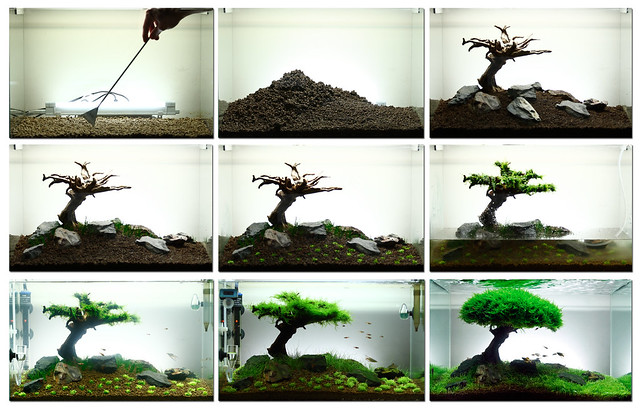

Step-by-step
First step: Cover the bottom of the aquarium with rich soil. I used ELOS Terra Zero and ELOS Bottom Mineral. Those products are very rich in nutrients (Micro and macro nutrients) and the plants will use it for a constant feeding, reducing the liquid fertilization on the aquarium since 1st week; Careful never let this products in contact with water column. ELOS Terra Zero is a powder and I use it for a long keeping term because plants when starts releasing their roots, they grow in direction of the bottom glass, so they will have always nutrients even after 1 year after setup. Then I covered entire bottom with ELOS Bottom mineral avoiding that the powder passes to the water column for some reason. This rich substrate can be used without Terra Zero, but depending on the quantity of the plants, it will lose some of its properties after 8~12 months. So, if you want to keep an healthy layout for a long time, I suggest the use of both products always well covered by the last layer of soil (ELOS Terra).

Second Step: Cover the entire bottom with ELOS Terra (Natural Soil) with a layer of 3~5cm on the front and 5~10cm on the back. Depending on the type of layout, we can give more depth to the layout creating a good slope of soil on the back.

Third Step: Place the wood and rocks giving a good appearance. This is the big challenge for all aquascapers or people that is just starting. It is not easy to choose the right hardscape and keeps it in proportion. Usually I take more than 1month looking for good pieces of wood and rocks to use on my layouts. If it is possible have more pieces of wood or rocks during the setup process and adapt what likes most for of each situation. In this case, I spent a lot of time preparing the wood that will simulate the tree, to be in scale and more realistic as possible. From a three pieces of Red Moor wood, I cut them and joined to give the best shape. After I tied the moss using fishing line (very thin) all over the small tiny branches and place the simulated tree on the aquarium. This will be the focal point; the first thing that people will see when look to the aquarium. Avoid centring the focal point; it should be placed on the sides but never closer to the glasses. Try to divide the aquarium in three parts and place it on 1/3 or 2/3. It was time to give more details to the layout; using small rocks we give more contrast to the foreground and delimit some areas of the aquarium.

Fourth step: Start planting. First we remove the wool from the plants (98% of the cases), separate the plant in a few parts (in case of foreground plants) and using a tweezers we plant the small pieces in order that they will be fixed and not totally covered by the soil. In case of using Hemianthus callitrichoides cuba or Utricularia graminifolia as foreground plant, they needs a special method to plant and preparation. We need to cut the wool without release the plant with 1 or 2cm, then cut the plant with the wool in several pieces and plant it with the wool. The wool will help to keep the plant in the soil and it will work like an anchor, avoid that plant release from the soil because of their tiny roots.

Final Step: Fill the aquarium with water very slowly, avoiding that the soil will be whirled around. We can cover the entire bottom with newspaper, this will help to keep the soil intact and when water gets half aquarium, the newspaper will start to float and can be removed.

6 months later and after several trimmings the result was this:
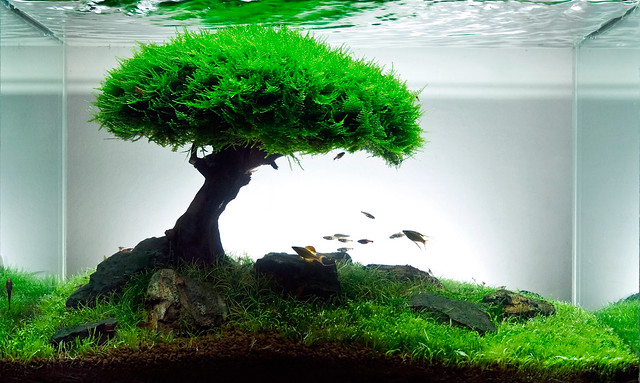

Pinus Pinea


Setup:
Name: Pinus Pinea
Size: 55x35x35 ( long*wide*tall) cm
Volume: 67L
Temperature: 25ºC
pH: 6,8
Lighting: 3x24w T5 6.500k
Filter: Aquaclear 25
CO2: ELOS Set ECO + Solenoid with 1bps
Substrate: Elos bottom mineral, Elos Terra zero, Elos Terra natural soil small grain (12L)

Fertilization:
Elos Fase1, Fase2, Extra1 and K40 by Elos Schedule program
Fase2 on Mon, Wed and Fri
Fase1 + K40 on Tue and Thur
Extra1 + K40 on Sat
with 0.5ml of each product


Maintenance: TPA once a week of 20%, usually I do it on Sunday.


Rocks: Schist
Wood decoration: Red Moorwood, DIY from 3 branches of wood
Plants: Eleocharis parvula, Utricularia graminifolia and Singapore moss (Vesicularia dubyana)
Fishes:
Otocinclus sp, Boraras maculatus and Iriatherina werneri
Invertebrate: Neocaridina heteropoda var. red and Caridina cf. cantonensis ‘Tiger’

Wednesday, May 25, 2011

ELOS Black Soil coming soon!

According to the brand, will be available very soon the new Black Soil Medium. New bags of 9.5L will be available instead of the atual 15L. So it will be possible to buy the 5L and 9.5L bags. As soon I receive more news about that I will share here!


Black Soil Medium

Coming soon, new articles about Reef Aquariums

From this point forward new articles about reef aquariums will be posted on this blog. My dear friend Danilo Ronchi of http://www.danireef.com/ accepted my invitation to be author of my blog. I want with his participation, share some good articles and turn my blog more useful for everybody. At same time I will share on his blog some articles about Aquascaping, tips and tricks. Stay tunned!!!!

Update of my 60L Aquarium with 40days after setup

Enjoy it! Please change to HD for better resolution.

Tuesday, May 24, 2011

Liquid Fertilization PART 2/3

Liquid fertilization part 2/3

This will be my first article about liquid fertilization. What I will write is according to all the tests that I have been done along these years of practice and not about what I did read over internet.
Fertilizing isn’t a scientific act that you should follow in a rigorous way; any aquarium is an aquarium and the conditions can be strictly different from one aquarium to another, even that we have used the same plants on them; light, CO2, general and carbonate hardness and soil could affect the liquid fertilization as well the way how your plants grows and consumes the nutrients.
Having a good and rich soil will reduce the doses of liquid fertilizer on water column because plants will be feed also from the roots and the availability of constant nutrients permits a good and healthy grow..

Bottom fertilizers

And if I didn’t use a rich soil, can I add some nutrients into the soil and renew it?
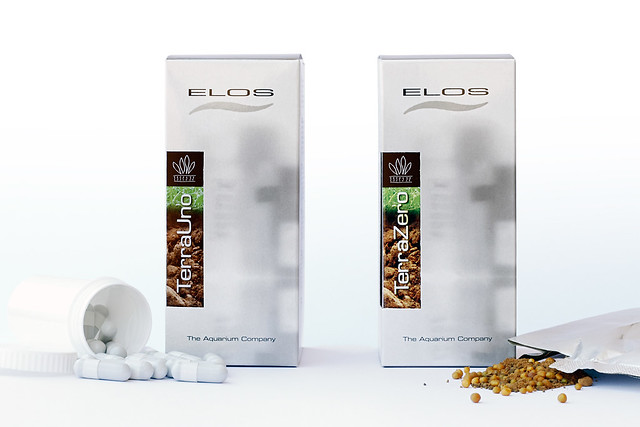
Yes, it is possible. In case of old substrate or it is possible to renew the soil adding some capsules of nutrients of ELOS TerraUno.

This will permits us to keep our planted aquarium with a small amount a liquid fertilization, quantity enough for the leaves have constant food during their photosynthesis. Plants metabolism could be normal to higher when exposed to high light and good quantity of carbon dioxide; but this subject will be explained on the 3rd part of this article.

Potassium:
The most important and complex nutrient for a planted aquarium is K (potassium). The non existence of a test for freshwater, turns this nutrient into a problem when used in a wrong way. Some problems that I have noticed using potassium, were in the past myths and related as a different source of problem.
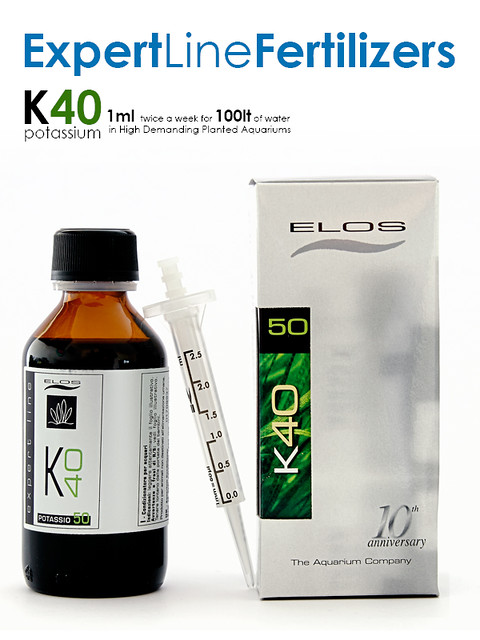
K40
Let’s see the case of the appearance of green dust algae.
Some people think that the problem is related to the lights; the use of bulbs dedicated to plants (pink bulbs) promotes the growing of these algae on glasses and hardscape… Are they right?! And about the lack of nutrients, could this cause this symptom? Bad or insufficient maintenance?
No, definitely not! The overdosing of Potassium is a big problem for all aquascapers and due my stubbornness, I just found the problem and how to control it.
If you dose K on the water and after 1 or 2 days you notice that your hardscape and/or glasses start getting green dust, it means that you add more potassium than plants need. In this case I suggest a water change in order to establish the balance of nutrients on water’s column and clean the glasses. The glasses will be your test for that! After, reduce the dose until the problem is solved, but try to keep it always on the water otherwise the other nutrients aren’t absorbed!
Green dust is an easy and fast way to notice that we are doing a bad liquid fertilization; if you don’t solve it and let it run like this, in a short time other algae will appear because excess of potassium will inhibit the assimilation of the other nutrients.

Phosphorous and Nitrates (NO3 and PO4):
There is a relation between both nutrients, if one doesn’t exist the other will not be assimilated by the plants; and if you don’t have K (potassium) none of both aren't absorbed!
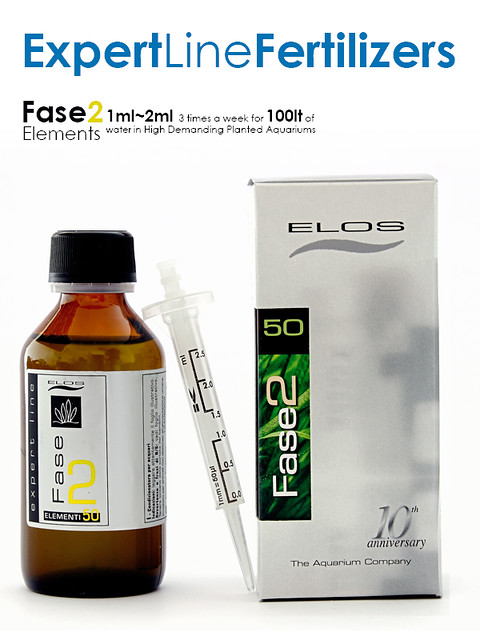
FASE2
How it works the NPK (it is known by Nitrate – phosphorous – Potassium)?
• Nitrates and phosphorous are assimilated if potassium is present.
• Nitrates are absorbed if phosphorous is present and vice versa.
• In case of lack or excess of Potassium, nitrates and phosphorous aren’t assimilated.

Which values of N and P shall I keep on a planted aquarium?
Most of people likes to use the proportion of 10:1ppm (NO3:PO4), but since I’m not using different compounds (powders) to fertilize my aquariums, I’m really happy with the proportion used by ELOS on FASE2 or Planta2, that is the 5:1ppm. What I like most on these fertilizers is the way how the NO3 is released on the water. The PO4 is measure in few minutes after we dose but the NO3 not. The chemical reaction of these fertilizers with the water is different of other brands, the NO3 has a very slow release and available very slowly on the water and only after some hours you can measure it. This is absolutely amazing when we have invertebrates and fishes very sensible to NO3 and in the case of nitrogen cycle, you can simply start dosing since the plants are adapted. Usually the values of phosphorous are null during nitrogen cycle and the values of Nitrates are very high, the slow release of NO3 from the fertilizer will not affect and raise the current values of NO3, but the opposite because you’re adding phosphorous in the water and the plants start growing very fast and absorbing the NO3 available on the water faster, reducing the nitrogen cycle for a half time (when used good enzymatic bacteria)… sometimes even faster. This is why I fertilize my aquariums very soon and most of people don’t understand why!

Iron and trace elements:
Iron is very important for plants because helps to fix the nitrogen and chlorophyll production. In high demanding planted aquarium, iron should been dosed regularly because the plants during their photosynthesis will absorb the nutrients very fast and metabolism works faster than normal; if there is a lack of this nutrient plants will start getting chlorosis, the new leafs born yellow and the old leafs get even worse; they will be very weak and after a short time will die.
Trace elements are always associated on Iron fertilizer because they help the plants absorbing the Iron and the other nutrients.
FASE1
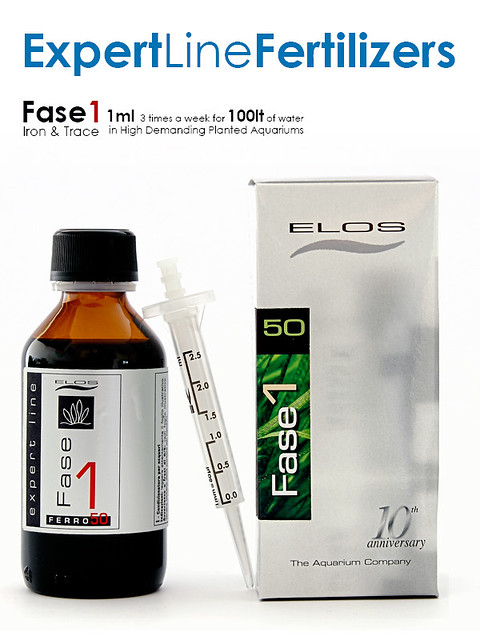
ELOS Fase1 is composed by chelated irons (Fe-EDDHA, Fe-DTPA, Fe-EDDCHA) and micro elements (boron, zinc, molybdenum, manganese etc.) and can be used as unique liquid fertilizer in low demanding planted aquariums.

As potassium, there isn’t available on the market Iron tests for chelated Iron, so it means that any brand that supplies iron water’s test for measuring the iron that they produces, they are selling “shitty” products and Iron is not chelated. Fertilizing with no chelated iron is the same of polluting the water, that iron will not be absorbed by the plants and if you fertilize on the same time with phosphorous, the probability of get filamentous algae is of 90%.

Along these years I have tested a lot of liquid fertilizers and most of them are a waste of time and money. Some people are really happy with them because after dosing 30ml, 50ml, 100ml daily, they say that it is an amazing fertilizer because their plants are fantastic and without any kind of algae; but they don't sit and think that they are spending money in one fertilizer with 95% of water… They are spending money in water!!!

Friday, May 20, 2011

New update of 60L Aquarium - 35 days after setup

35 days after setup and the layout continues in good shape and the plants growing very well. I took this picture today after weekly maintenance and after add the fishes. I just found again the Micro rasbora and I didn't resist. I hope to have more luck this time... for sure I will smell and taste the water before any water change, just in case!!!!

One Step Closer

Thursday, May 19, 2011

2º Meeting of Aquarium hobby in Salvaterra

During last weekend I have been in Salvaterra de Magos for the 2º Meeting of Aquarium hobby of Salvaterra. During that event I did an interactive planted workshop, that IMHO it did work very well. Take a look on video.

Wednesday, May 11, 2011

Liquid Fertilization PART 1/3

What we should know about liquid fertilization?

Very simple... We need to divide the subject in 3 parts; measure the levels of nutrients choosing the right tests, use a good liquid fertilizer with nutrients required by plants and find the balance between nutrients vs CO2 and Lighting.

PART1: Choosing the right tests

What really makes me some confusion is when I talk with somebody about planted aquariums and maintenance, they refer that are using powders to fertilize their aquariums without knowing what are doing... They read somewhere that for keeping aquatic plants in aquarium need phosphorous, nitrates and potassium; basis nutrients as known by NPK. It is too scary listen those people saying that dose 20ml daily of each or even more, depending on the size of the aquarium... but the plants really need such quantity of liquid fertilizer? Unless the concentration of each liquid fertilizer is too small that can permits to add to the water's column what I usually call of Water's fertilizer; 98% of water with 2% of nutrients! But this is not a problem, the main problem is they are doing that without knowing the measures because they don't use tests and when they have it, don't have the right ones. Please don't make confusion with NO2 and NO3, both began with the letters "NITR", but one is Nitrites and other is Nitrates.

To keep a planted Aquarium you will need several tests like PO4 (phosphates), NO3 (nitrates), gH (general hardness), kH (carbonate hardness) and pH (acidity test).

Do we need all of them?!
If you want to keep and know what is happening with your aquarium, you should have them and not wait too long to make some tests when something really happens. Usually I compare this with insurances; people that have them are always complaining about the money that spend with them without taking any benefit, until someday when something happens, they regret for don't have it or gave up because they didn't need it.

Tests are more or less the same, we can have them for a long time without using them, but when the plants get algae, are doing meltdown or weak, some fishes start dieing... something is not right; and if you can take care of the problem as soon as possible, better for the healthy of your plants and fishes.

And what about strips tests, are they good?
The strips tests and even some drops tests aren't too good... to have an idea of the measure values they are nice but not good because most of the time give us different values even when you do it 2 or 3 times in a row.
I remember one time that I was doing a maintenance at one planted aquarium that was full of algae and the test used gave nitrates always above 25ppm. I will not reveal the brand, but I can assure that I will never use or recommend that to a friend or customer. On that tank we have done several water changes waiting that NO3 get normal values or stay near of zero without success. We tested the tap water and the values of NO3 were really high, finally we discover the problem; it was the tap water... or not, because this is not the end of the story! This situation was so strange because the plants stopped growing and all the nutrients were there; The aquarium was well equipped with CO2 and Lighting, no visible reason for that. It was when I remembered to use a different test from other brand; surprisingly the water wasn't NO3 at all!!!! Not satisfied, I used my own tests and the water of the aquarium and tap water were free of Nitrates... The plants were plenty of algae because of a lack of nutrient and not excess.

If this happened to me and I was using tests (the bad tests on the beginning), I really don't understand how people can keep a planted aquarium without them.

You can see if a test is good or not when you do several tests in short period of time; if the results are different from one test to another, those tests are nice to have an idea but not good to have precise values. Having 10ppm of nitrates is not the same of having 20ppm.

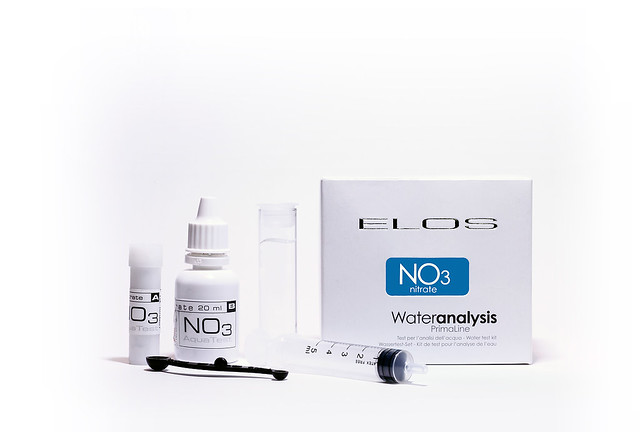
The ELOS NO3 test Kit is precise and unique on the market. You can measure the nitrates of your aquarium in a scale of 1ppm~25ppm (1-2.5-5-10-25ppm); to do the test you only need to use 5ml of water into a vial, measure spoon of 0,15ml of Reagent A and 6 drops of Reagent B; very simple and easy!

NitratesTestKit


Tests of gH and kH are really needed?
Any planted aquarium that uses argyle as a soil, wood and CO2 usually the water change a little bit his own properties. It become more soft and sometimes we have big surprises.

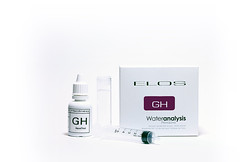
Carbon Hardness TestKitGeneral Hardness TestKit

General hardness gH is what distinguish from soft to hard water, because the results of the hardness depends of the quantity of Magnesium and calcium dissolved on the water. Aquatic plants grow faster if we have soft water around 4~8º; the availability of calcium and magnesium are enough to avoid lack of nutrients and in case of lack, we can simply add Trace elements on the water to solve the problem. When the hardness is too hard, I'm not refering to values between 8~14º but even higher, this problem can be solved using RO Water (reverse osmosis) during water changes. I have been noticed that some plants likes a little bit hardness, in some situations raise the values to 10~15º will enhance the coloration and the way how the plants grow. Stem plants will grow or expand more on horizontal and will be kept for more time below the lighting, enhancing their colouration and get more reds. Increasing the hardness will also increase the difficult on keeping the planted aquarium, because if they don't grow so fast as before, we need to control again the routine fertilization.

To raise the values of gH, I recommend the use of ELOS Rigenera because contains the right proportion of Calcium and Magnesium.

Carbonate hardness kH needs to be above 3º to have a stable aquarium, otherwise the water can be very acid and we have a big problem for plants and fishes because pH goes down very quickly and could pass from 7 to 4 without you noticed that. Some plants start doing meltdown and disappear from the aquarium; please don't make confusion with cryptocorynes. This plant can simply do a meltdown when some parameters oscillate, don't panic because in a few days (2 weeks) will born again. The general meltdown of some plants (not cryptocoryne) can result from the high acidity of the water. In case of you need to raise carbonate hardness of the water you can use Kh+ (buffer) slowly to avoid great oscillation of water's parameter.